

If your drivers are operating commercial motor vehicles with a GVWR over 26,001 lbs, transporting hazardous materials, or driving vehicles designed to carry 16 or more passengers, a written drug and alcohol policy is a federal requirement — not a best practice, not a nice-to-have, and not something you can patch together after an inspection.
The Foundation: What FMCSA Part 382 Requires
The Federal Motor Carrier Safety Administration’s regulations at 49 CFR Part 382 establish a comprehensive drug and alcohol testing program for all employers who employ drivers subject to the Commercial Driver’s License (CDL) requirements. At the heart of that program is a written policy — a documented, distributed, and signed commitment to a drug- and alcohol-free workplace.
The FMCSA doesn’t just want you to have a testing program. It wants you to communicate that program clearly, in writing, so that every covered driver understands the rules before they ever turn a key.
What Must Be in Your Written Policy
Under 49 CFR Part 382 and related provisions, your written substance abuse policy must cover specific subject matter. A vague “we don’t tolerate drugs” memo does not satisfy the requirement. The policy must address (see Required Content) :
- The categories of prohibited conduct:
- Use, possession, sale, or being under the influence of controlled substances or alcohol while performing safety-sensitive functions. This includes alcohol use within four hours of performing safety-sensitive duties and alcohol concentration of 0.04 or greater while on duty.
- The circumstances requiring testing:
- Pre-employment, random, post-accident, reasonable suspicion, return-to-duty, and follow-up testing must each be described. Drivers need to understand when they can be called for a test and what triggers each type.
- Testing procedures:
- A general description of how testing is conducted — urine specimens for drugs, breath or saliva for alcohol — and that testing follows the procedures set out in 49 CFR Part 40, the DOT’s testing procedure regulations.
- Consequences for violations:
- What happens if a driver tests positive, refuses to test, or is found to have violated any prohibition. This must include removal from safety-sensitive functions and the referral requirement to a Substance Abuse Professional (SAP).
- Consequences for refusing to submit to testing:
- Refusal to test is treated as a positive result under FMCSA regulations. Your policy must make this explicit. Drivers who refuse are immediately removed from safety-sensitive functions.
- Information on SAP and rehabilitation resources:
- 49 CFR §382.601 requires that you provide information about any Substance Abuse Professionals.
- Supervisor training disclosures:
- The policy should reference that supervisors are trained to identify behaviors and signs that may indicate drug or alcohol use, consistent with the 60-minute training requirement under §382.603.
Why the Employee Signature Is Not a Formality
Here is where many carriers stumble. The policy exists in a three-ring binder, or a PDF on the company drive, and drivers are expected to read it. But the FMCSA requires more than availability — it requires proof of receipt.
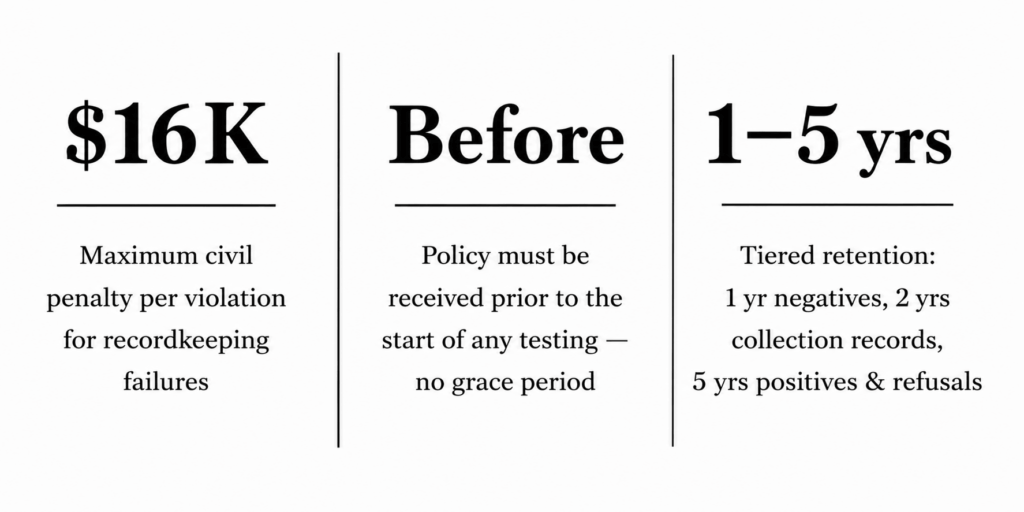
Under 49 CFR §382.601(b), each employer shall provide the written policy statement to each driver prior to the start of alcohol and drug testing and shall provide written notice to each driver of the employer’s policy when the employer makes any changes to the policy.
“Each employer shall provide the written policy statement to each driver… and shall make it available to all drivers covered by this subpart.”
49 CFR §382.601 — FMCSA
The signed acknowledgment form — like the sample acknowledgment form referenced above — closes the loop. It establishes a documented record that the driver received the policy, was given the opportunity to read it, and agreed to abide by it as a condition of employment. That signature is your legal protection and your compliance documentation in one.
What the acknowledgment form should capture
A complete receipt and acknowledgment form should document all of the following:
- The driver’s full printed name
- A statement that the driver has received, read, and understood the written drug and alcohol policy
- The date the policy was received (not the date of hire — the date the policy was actually given)
- The driver’s signature
- The driver’s Social Security Number or employee ID for positive identification in the driver qualification file
- The employer’s signature or representative signature
- A witness signature and date (strongly recommended, and required by some carriers’ internal procedures)
Sample Acknowledgment: What It Looks Like in Practice
The following is an example of the type of acknowledgment form carriers should have drivers execute. This form documents that the driver has received the policy and agrees to comply with its terms as a condition of continued employment.
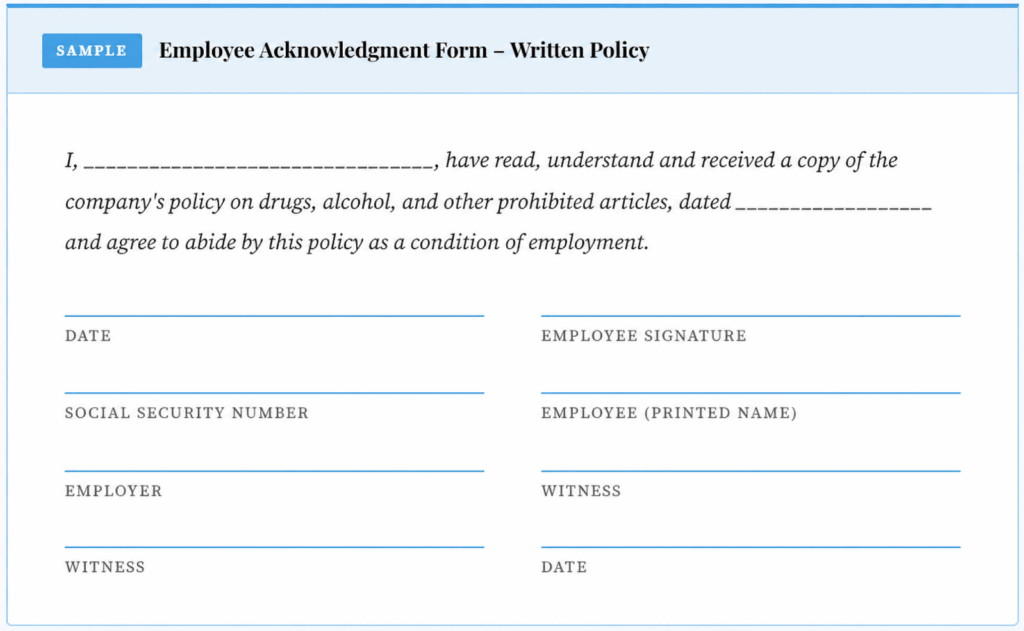
This acknowledgment form should be placed in every driver’s qualification file and retained for the duration of the driver’s employment plus three years, consistent with FMCSA record retention requirements.
Why Carriers Get This Wrong
The most common failure modes during DOT audits and compliance reviews aren’t carriers who have no policy at all. They’re carriers who have a policy but can’t prove drivers received it. A policy in a filing cabinet is not the same as a policy that was distributed, explained, and acknowledged.
⚠ Common Compliance Gap
Updating a drug and alcohol policy — changing your random testing rate, switching testing consortia, or revising prohibited conduct language — triggers the re-notification requirement. Every driver must receive, review, and sign acknowledgment of the updated policy. Many carriers notify drivers verbally and never document the update.
Part 382 at a Glance: Quick Reference Summary
Who is covered
All employers who employ drivers required to hold a CDL, including owner-operators who lease to a carrier. The regulations cover drivers operating vehicles with a GVWR or GCWR of 26,001 lbs or more, vehicles designed to carry 16 or more passengers, and vehicles transporting hazardous materials requiring placarding.
Prohibited substances tested under Part 40
The DOT drug testing panel covers marijuana (THC), cocaine, amphetamines (including methamphetamine and MDMA), opioids (including codeine, morphine, hydrocodone, hydromorphone, oxycodone, oxymorphone, and heroin), and phencyclidine (PCP). Alcohol testing measures breath alcohol concentration (BrAC).
Minimum random testing rates (current)
The FMCSA sets random testing rates annually. Currently (2026), the minimum random drug testing rate is 50% of covered drivers per year, and the minimum alcohol testing rate is 10%. Rates are subject to change based on industry-wide violation data.
Key record retention requirements
- Alcohol test results of 0.02 or greater: 5 years
- Drug test results that are verified positive: 5 years
- Refusal to test documentation: 5 years
- SAP referrals and return-to-duty records: 5 years
- Negative drug test results: 1 year
- Records related to the testing process (calibration, collection site): 2 years
- Education and training records: Duration of employment plus 2 years
What to Do Right Now
If you are not certain that your substance abuse policy meets Part 382 requirements — or if you have drivers in your fleet without a signed acknowledgment form on file — the time to act is before an inspection, not during one.
Start here:
- Pull your current written drug and alcohol policy and verify it covers all required elements under §382.601
- Audit your driver qualification files for signed acknowledgment forms for every active driver
- Identify any drivers hired or policy updates made without a corresponding signed receipt
- Implement a process to obtain acknowledgments before a new driver’s first day behind the wheel
- Store signed forms in each driver’s DQ file and ensure they are accessible for review
Your written substance abuse policy is more than a compliance checkbox. It is the document that defines your expectations, protects your company, and gives drivers a clear understanding of the rules they agreed to follow. The signature on the acknowledgment form is the moment that policy becomes enforceable — and the moment your program becomes defensible.
Ready to Get Your Files in Order?
DriverFileHub provides the forms, templates, and compliance tools carriers need to manage driver qualification files with confidence.