

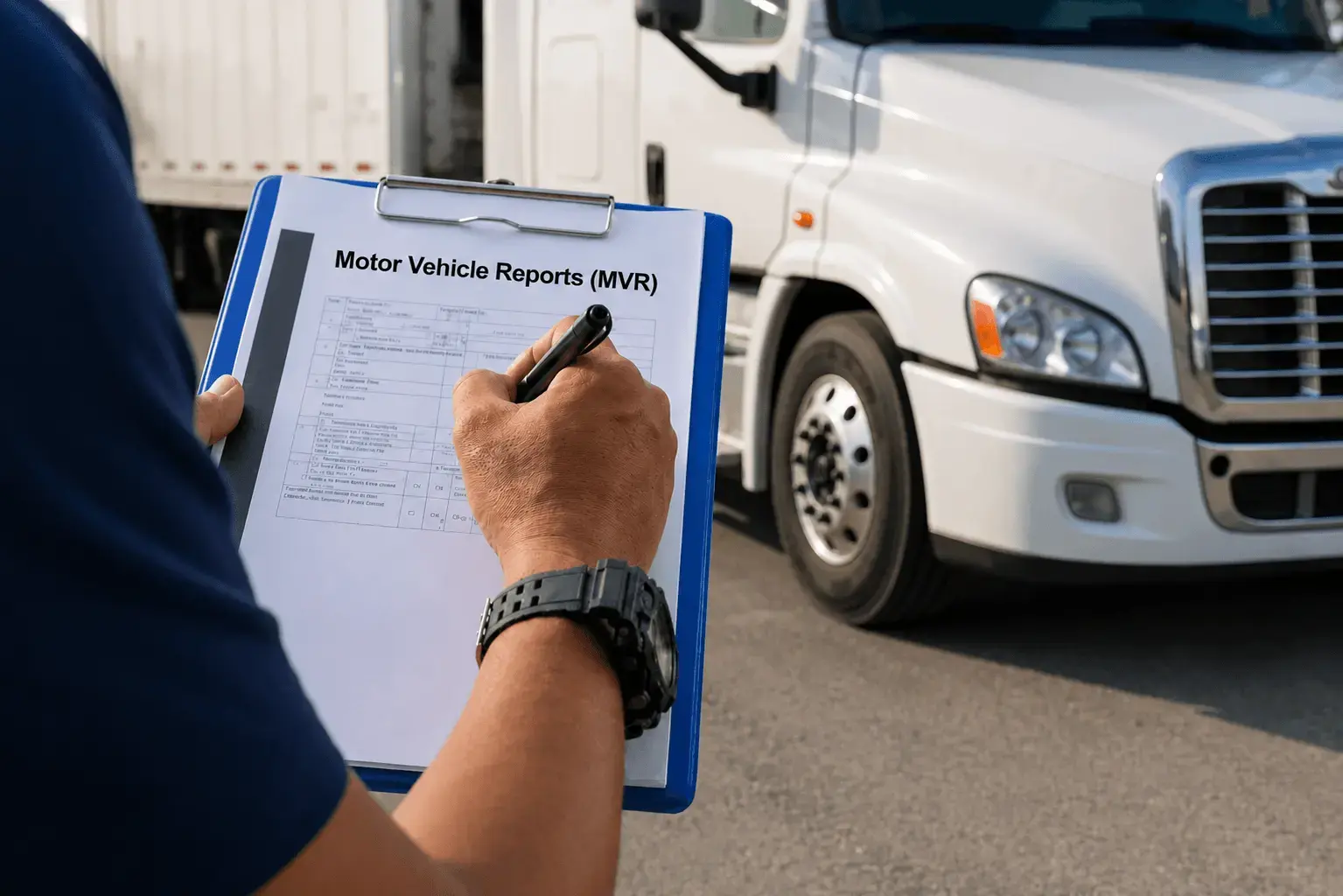
What every motor carrier must check at hire and annually — and the steep penalties for those who don’t comply with 49 CFR § 391.23.
What Is a Motor Vehicle Report (MVR)?
A Motor Vehicle Report (MVR) is an official report generated by a state’s Department of Motor Vehicles (DMV) or driver licensing agency that documents a driver’s complete licensing and driving history. For motor carriers regulated by the Federal Motor Carrier Safety Administration (FMCSA), MVRs are a non-negotiable cornerstone of the Driver Qualification (DQ) File — the federal record every carrier must maintain for every employed driver.
The MVR provides a verified, government-issued snapshot of a driver’s license status, endorsements, restrictions, violations, disqualifying offenses, and — for CDL holders — medical certification status. No amount of self-reporting by the driver can substitute for it.
📋 Regulatory Foundation
The FMCSA’s driver qualification requirements are codified in 49 CFR Part 391. MVR requirements specifically appear under § 391.23 (pre-employment investigation) and § 391.25 (annual review).
When Are MVRs Required? At Hire & Annually
At Time of Hire (Pre-Employment)
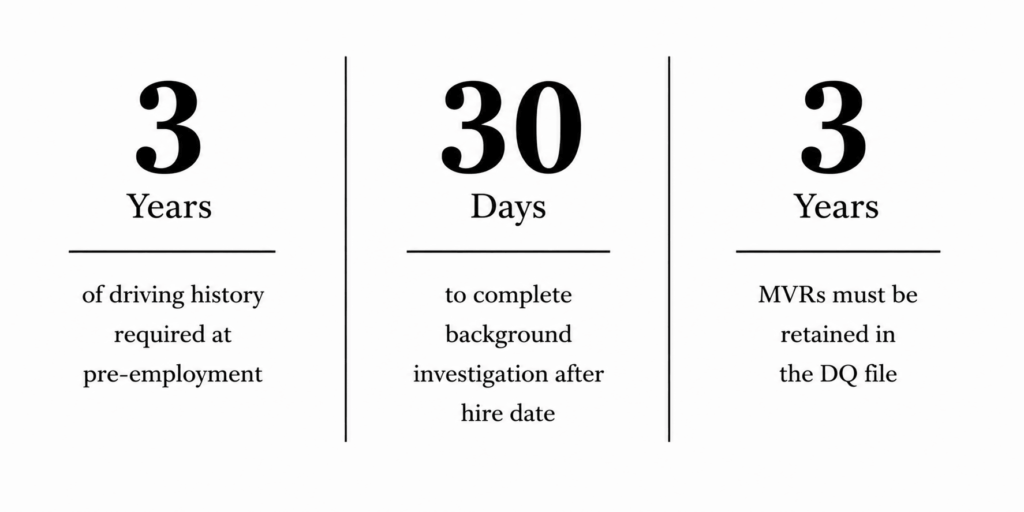
Before a driver operates a commercial motor vehicle (CMV) for your company, you must pull an MVR from every state where the driver held a license or permit during the previous three years. This is not limited to the driver’s current licensing state — if they held a license in two or three states over the past three years, you must obtain records from each of them.
⚠️ Important Deadline
Under 49 CFR § 391.23, the full investigation of a new driver’s safety performance history must be completed within 30 days of the driver’s first day. Missing this window is itself a citable violation.
Annually (Every 12 Months)
Compliance doesn’t end at hire. Under 49 CFR § 391.25, every motor carrier must pull and review a fresh MVR for each employed driver at least once every 12 months. Critically, this is a rolling deadline unique to each driver — not a single calendar-year sweep for the entire fleet. Missing the 12-month window for even one driver is a federal violation.
After reviewing the annual MVR, the reviewer must place a notation in the DQ file that includes their name and the date the record was reviewed. That documentation step is required under § 391.25(c)(2). Learn more about maintaining a complete DQ file with Driver File Hub.
What Employers Should Look for on an MVR
Pulling an MVR is only half the job. The regulation requires you to review it to determine whether a driver meets minimum safe driving requirements or is disqualified from operating a CMV. Here is what a thorough review covers:
- License Status, Class & Endorsements
- Confirm the license is valid and not suspended, revoked, or expired. This seems obvious, but auditors regularly find carriers employing drivers whose licenses were silently downgraded or placed under administrative suspension without the carrier’s knowledge. Also verify that the license class (A, B, or C) matches the vehicle the driver is operating.
- Moving Violations & Disqualifying Offenses
- Review the violation history carefully. Under 49 CFR § 391.15, certain offenses disqualify a driver entirely, including:
- Driving under the influence (DUI/DWI) of alcohol or a controlled substance
- Leaving the scene of an accident
- Using a CMV to commit a felony
- Causing a fatality through negligent operation of a CMV
- Driving a CMV while revoked, suspended, or disqualified
- Two or more serious traffic violations within three years (e.g., excessive speeding, reckless driving, improper lane change)
- Review the violation history carefully. Under 49 CFR § 391.15, certain offenses disqualify a driver entirely, including:
- Accident History
- Many states report at-fault accidents on the MVR. Patterns of accidents — even minor ones — are a key safety signal. Cross-reference the MVR’s accident history against the employment application and any PSP (Pre-Employment Screening Program) report from the FMCSA PSP portal. (PSP checks are integrated into the Driver File Hub platform)
- Points Accumulation
- Most states assign point values to violations. Heavy point accumulation — even for non-disqualifying offenses — signals a driver with a problematic pattern of risk-taking. Many carriers set internal thresholds (e.g., no more than 5 points in 3 years) as part of their safety culture. The FMCSA’s CSA program also tracks violations that affect your Safety Measurement System (SMS) score.
- Drug & Alcohol Clearinghouse
- Since January 6, 2023, pre-employment queries to the FMCSA Drug and Alcohol Clearinghouse are required to satisfy the inquiry requirements under § 391.23(e)(4). This is separate from — but complements — the MVR review. Employers must also run annual limited queries for every employed CDL driver.
💡 Pro Tip
Each state’s MVR lookback period varies — some report violations for three years, others for seven to ten. Always order an extended or certified MVR when available to maximize visibility into a driver’s history.
Verifying CDL Class A & Class B Licenses
If your operation involves drivers with a Commercial Driver’s License (CDL), confirming the license class is one of the most critical elements of MVR review. Operating the wrong vehicle with the wrong CDL class is a federal violation — and any employer who allows it bears direct liability.
What Each Class Means
| CDL Class | Vehicle & Weight Threshold | Common Examples |
|---|---|---|
| Class A | Any combination of vehicles with a GCWR of 26,001+ lbs., where the towed unit exceeds 10,000 lbs. | Tractor-trailers, semi-trucks, double/triple trailers, tankers with trailer |
| Class B | Single vehicles with a GVWR of 26,001+ lbs., or towing a vehicle ≤ 10,000 lbs. | Straight trucks, large buses, dump trucks, box trucks, some tankers |
| Class C | Vehicles not covered by A or B, designed to carry 16+ passengers or placarded hazmat. | Passenger vans, small HazMat vehicles |
🚨 Critical Verification Step
A driver holding only a Class B CDL cannot legally operate a Class A combination vehicle. Don’t take the driver’s word for it — the MVR will show the exact license class issued by the state. Verify it on every pre-hire MVR and confirm it has not been downgraded on every annual review. See 49 CFR Part 383 for federal CDL standards.
Endorsements to Confirm
In addition to the base CDL class, verify that any required endorsements are active on the license. Common endorsements include:
- H — Hazardous Materials (requires TSA background check)
- N — Tank Vehicles
- T — Double/Triple Trailers
- P — Passenger Vehicles
- S — School Bus
- X — Combination of Tank + HazMat
Endorsements can expire or be revoked independently of the base CDL. Annual MVR review is your safeguard against an endorsement lapsing without your knowledge.
Medical Certification & the CDLIS MVR
Confirming that a driver is medically qualified to operate a CMV is a requirement under 49 CFR § 391.41. The process changed significantly in 2025 — here is what employers need to know today.
The 2025 Medical Certification Integration Rule
Effective June 23, 2025, the FMCSA phased in its Medical Examiner’s Certificate (MEC) Integration Rule. Medical examiners are now required to upload exam results directly to the FMCSA National Registry by midnight of the day following the exam. The results are then transmitted electronically to the driver’s State Driver Licensing Agency (SDLA) and reflected on the driver’s MVR.
For CDL and CLP holders, this means:
- Drivers no longer carry paper Medical Examiner’s Certificates (MECs)
- Motor carriers verify medical certification status through the CDLIS MVR, not a paper card
- The MVR must show the driver’s medical status and expiration date before the driver operates a CMV
- Carriers no longer need to verify the medical examiner’s National Registry credentials for CDL drivers (as of 6/23/25)
For non-CDL CMV drivers, the old process remains: drivers must carry paper medical cards, and employers must maintain copies in the DQ file and verify the examiner is listed on the FMCSA National Registry of Certified Medical Examiners.
What to Check on the Medical Certification Section of the MVR
- Medical certification status: Certified (not “Not Certified” or blank)
- Medical certification expiration date — it must not be expired
- Self-certification category (interstate non-excepted is the most common for regulated carriers)
- Any Skill Performance Evaluation (SPE) certificate noted, if applicable for drivers with physical impairments
⚠️ Active Waiver — Updated May 2026
The NRII electronic medical certification system has been slower to roll out than planned. As of April 2026, five states had still not completed the transition. The FMCSA has issued a fifth consecutive waiver extension, effective April 11, 2026 through October 11, 2026, which allows CDL/CLP holders and their motor carriers to use a paper copy of the Medical Examiner’s Certificate (MEC) as valid proof of medical certification for up to 60 days after it was issued. The paper MEC must be replaced by an updated CDLIS MVR showing medical certification status within that 60-day window. FMCSA also strongly recommends that certified medical examiners continue issuing paper certificates in addition to electronic submission until further notice. Check the FMCSA Medical Certification page for the latest waiver updates, and use Driver File Hub’s MVR monitoring to receive automatic alerts when a driver’s medical status updates on the MVR.
Penalties for Non-Compliance with 49 CFR § 391.23
The requirements of 49 CFR § 391.23 are not suggestions — they are federally enforceable mandates. Carriers who fail to conduct required investigations, pull MVRs, or maintain proper documentation face a layered system of consequences that can threaten the survival of a business.
Civil Monetary Penalties
Under 49 CFR Part 386, Appendix B — the FMCSA’s official penalty schedule, adjusted annually for inflation — violations of the Federal Motor Carrier Safety Regulations carry the following fines:
| Violation Type | Maximum Penalty (Per Violation) |
|---|---|
| Non-recordkeeping violations (Parts 390–399, including § 391.23) | Up to $19,246 |
| Recordkeeping violations (missing documentation, incomplete DQ files) | Up toUp to $1,584 per day, capped at $15,846 |
| Driver non-recordkeeping violations | Up to $4,812 |
| Knowing falsification of records | Up to $15,846 |
| Egregious or knowing/willful violations | Up toSource: 49 CFR Part 386, Appendix B — updated annually for inflation. Figures reflect the 2026 adjustment effective February 19, 2026. |
Source: 49 CFR Part 386, Appendix B — updated annually for inflation. Figures reflect the 2026 adjustment effective February 19, 2026.
These amounts are per violation. If a DOT auditor reviews your fleet and finds that you failed to run proper pre-employment MVRs for five drivers, that is five separate violations. Fines escalate rapidly with repeat or pattern non-compliance.
CSA Score Damage
Every violation of § 391.23 adds points to your Compliance, Safety, Accountability (CSA) score in the Driver Fitness BASIC (Behavior Analysis and Safety Improvement Category). A deteriorating CSA score triggers increased audit scrutiny, subjects your company to Interventions by the FMCSA, and is publicly visible to shippers and brokers who may choose not to work with high-risk carriers. Review your current SMS score at ai.fmcsa.dot.gov/sms.
Negligent Hiring Liability
The civil and regulatory penalties are only part of the picture. If a driver involved in a crash had a disqualifying offense that an MVR check would have revealed, your company faces exposure to negligent hiring litigation. Plaintiff attorneys routinely argue that a carrier’s failure to conduct compliant background investigations demonstrates reckless disregard for public safety — a standard that can support punitive damages far exceeding regulatory fines.
Loss of Operating Authority
Persistent or egregious non-compliance can result in the FMCSA issuing an Unsatisfactory safety rating or, in the most severe cases, placing your carrier Out of Service — meaning your trucks stop moving entirely until compliance is demonstrated. The FMCSA Civil Penalties and Settlement page outlines how enforcement cases are initiated and resolved.
🚨 Common Audit Triggers for § 391.23 Violations
DOT auditors specifically look for: failing to complete investigations within the 30-day deadline; not pulling MVRs from every state a driver held a license; missing annual review documentation; and incomplete or absent employment history inquiries. These are among the most frequently cited DQ file violations nationwide.
Academic Context: The Cost of Traffic Safety Non-Compliance
Research consistently validates the importance of rigorous driver screening. The Transportation Research Board (TRB) — a program of the National Academies of Sciences, Engineering, and Medicine — has documented that motor carriers with structured hiring and monitoring programs, including MVR review, have significantly lower crash involvement rates. Pre-employment screening of CMV drivers is foundational to fleet safety programs studied in transportation safety literature across institutions including academic transportation research centers.
Sources & Official References
- U.S. Government — Electronic Code of Federal Regulations: 49 CFR § 391.23 — Investigation and Inquiries (ecfr.gov)
- U.S. Government — Electronic Code of Federal Regulations: 49 CFR § 391.25 — Annual Inquiry and Review of Driving Record (ecfr.gov)
- U.S. Government — FMCSA: Medical Certification Requirements for CMV Drivers (fmcsa.dot.gov)
- U.S. Government — FMCSA: Civil Penalties and Settlement (fmcsa.dot.gov)
- U.S. Government — FMCSA Motor Carrier Safety Planner: Driver Qualification File Requirements (csa.fmcsa.dot.gov)
- U.S. Government — FMCSA CSA: Safety Measurement System (SMS) (fmcsa.dot.gov)
- U.S. Government — FMCSA Clearinghouse: Drug and Alcohol Clearinghouse (clearinghouse.fmcsa.dot.gov)
- U.S. Government — Electronic CFR Penalty Schedule: 49 CFR Part 386 Appendix B — FMCSA Penalty Schedule (ecfr.gov)
- Transportation Research Board — National Academies: Transportation Research Board Database (trid.trb.org)
- U.S. Government — Federal Register: Record of Violations Final Rule — 49 CFR 391.27 Rescinded (federalregister.gov)
- Legal Information Institute — Cornell Law School: 49 CFR § 391.23 Full Text (law.cornell.edu)