

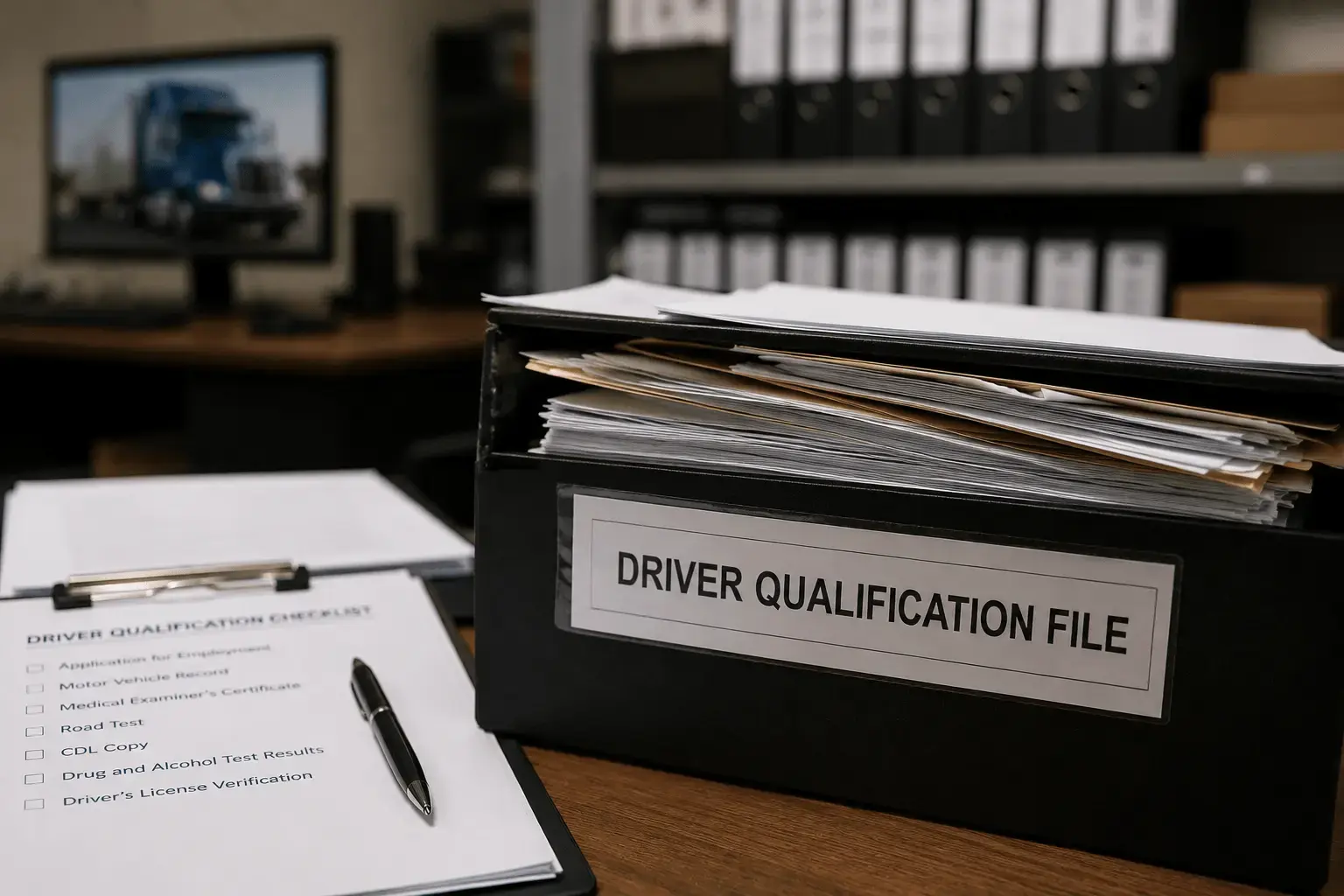
An incomplete driver qualification file (DQ file) is one of the most common violations discovered during FMCSA audits and roadside inspections. Every commercial motor carrier is required to maintain a complete file for each driver under 49 CFR § 391.51.
This federal requirement exists for one reason: to ensure that drivers are legally qualified and physically fit to operate commercial motor vehicles safely.
Failure to maintain proper documentation can result in violations, fines, higher CSA scores, and increased insurance costs.
What Does 49 CFR § 391.51 Require?
Under 49 CFR § 391.51, motor carriers must maintain a driver qualification file for every employed driver. The DQ file may be combined with the employee’s personnel file, but all required documents must be present and current.
Here’s what must be included:
1. Driver’s Application for Employment (49 CFR § 391.21)
Before operating a commercial motor vehicle, a driver must complete and sign an employment application that complies with federal requirements.
The application collects:
- Employment history
- Driving history
- Accident history
- License information
This document proves the carrier verified the driver’s background prior to hire.
2. Initial Motor Vehicle Record (MVR)
Carriers must obtain a motor vehicle record from every state where the driver holds or has held a license.
The MVR confirms:
- Traffic violations
- Suspensions or revocations
- Overall driving history
Keeping the initial MVR in the DQ file demonstrates due diligence during the hiring process.
3. Road Test Certificate or Equivalent (CDL Exception)
Drivers must pass a road test unless they hold a valid Commercial Driver’s License (CDL) that the carrier accepts as equivalent.
The file must include:
- The road test certificate
OR - Documentation showing CDL equivalency was accepted
This verifies the driver demonstrated the skills necessary to operate safely.
4. Annual Motor Vehicle Record
Carriers must obtain an updated MVR at least once every 12 months.
The annual MVR ensures:
- No new violations have occurred
- The license remains valid
- The driver continues to meet safety standards
5. Annual MVR Review Note
Simply obtaining the MVR is not enough. Carriers must document that someone reviewed it.
The note must include:
- The reviewer’s name
- The date of review
This written record proves the carrier actively monitors driver safety performance.
6. Medical Examiner’s Certificate (49 CFR § 391.43)
Drivers must pass a DOT physical performed by a certified medical examiner and receive a certificate under 49 CFR § 391.43.
The DQ file must include:
- The medical examiner’s certificate (original or copy)
OR - A CDLIS motor vehicle record showing medical certification status (for CDL drivers)
If the driver has a medical variance, that documentation must also be included.
7. Skill Performance Evaluation (SPE) or Medical Exemption
If applicable, the file must contain:
- Skill Performance Evaluation Certificate
- Medical exemption documentation
These records confirm the driver is legally authorized to operate despite certain medical conditions.
8. Verification of Medical Examiner’s National Registry Listing
For non-CDL drivers, carriers must verify that the medical examiner is listed on the National Registry of Certified Medical Examiners.
For CDL drivers, this verification requirement applies through June 22, 2025.
This ensures exams are performed by qualified professionals recognized by the Federal Motor Carrier Safety Administration.
How Long Must Driver Qualification Files Be Kept?
FMCSA regulations require carriers to maintain DQ files:
- For the entire period of employment
- For three years after employment ends
Certain documents may be removed three years after execution, including:
- Annual MVRs
- Annual MVR review notes
- Medical examiner’s certificates
- Medical variance documentation
- Registry verification notes
Maintaining proper retention schedules keeps files organized while remaining compliant.
Why Incomplete DQ Files Are a Serious Compliance Risk
Every required document serves a specific purpose. Missing records prevent the FMCSA from verifying that a driver met federal qualification standards before operating a commercial vehicle.
Consequences of incomplete driver qualification files include:
- FMCSA violations during audits
- Civil penalties and fines
- Increased CSA scores
- Driver disqualification
- Higher insurance premiums
Incomplete files are frequently cited during compliance reviews conducted by the Federal Motor Carrier Safety Administration.
Relationship to Drug and Alcohol Testing Compliance
Driver qualification files are separate from drug and alcohol testing records. However, both are critical to overall safety compliance.
Carriers must also comply with:
When DQ file deficiencies are combined with drug testing gaps, enforcement actions become significantly more likely.
Best Practices to Avoid DQ File Violations
To reduce risk:
- Use a standardized DQ file checklist
- Audit files annually
- Track medical certificate expiration dates
- Automate MVR pulls where possible
- Maintain clear documentation of reviews
Proactive recordkeeping protects your company, your drivers, and the public.
Final Thoughts: Compliance Is More Than Paperwork
Incomplete driver qualification files remain one of the most common FMCSA violations. Federal law clearly outlines what must be maintained and for how long.
A complete DQ file proves that your driver is:
- Legally qualified
- Medically certified
- Properly vetted
- Continuously monitored
Maintaining accurate driver qualification files is not just an administrative task — it directly supports safer highways and stronger compliance programs.