

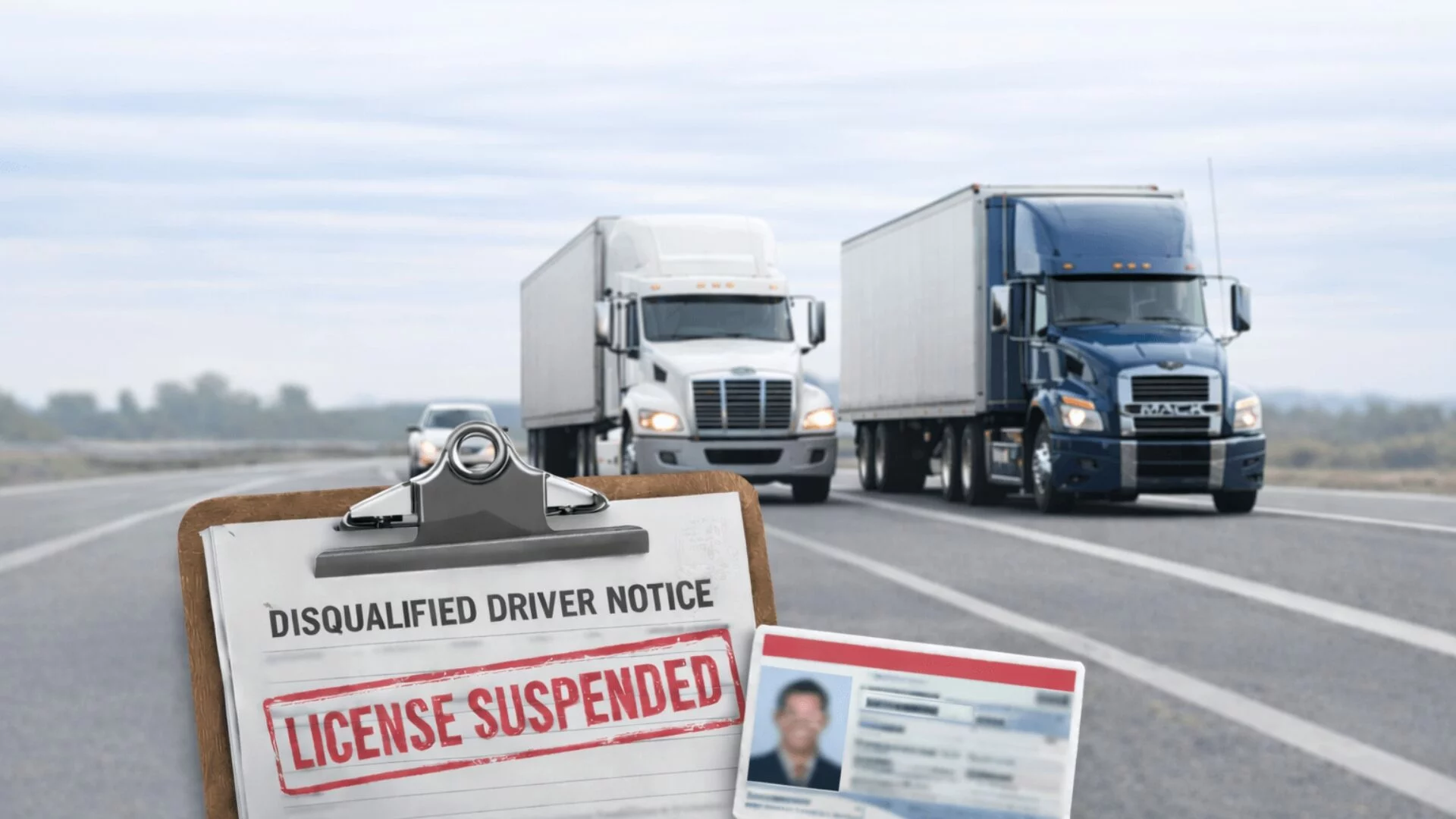
What This FMCSA Violation Means
Federal safety regulations strictly prohibit a driver from operating a commercial motor vehicle while disqualified. A safety-related disqualification means the driver lost the legal right to drive because of actions that directly affect road safety. When a disqualified driver continues to operate a CMV, both the driver and the motor carrier violate federal law.
The Federal Motor Carrier Safety Administration enforces this rule under 49 CFR § 391.15. The regulation makes clear that a motor carrier may not require or permit a disqualified driver to drive a CMV under any circumstances.
General Rule on Disqualification
Federal law states that a driver who is disqualified must not drive a commercial motor vehicle. At the same time, a motor carrier must not allow or require that driver to operate a CMV. This rule applies immediately once a disqualification takes effect.
Definition of a Commercial Motor Vehicle under Part 391:
A Commercial Motor Vehicle (CMV) is defined as any motor vehicle used on a highway in interstate commerce to transport property or passengers when the vehicle:
- Has a gross vehicle weight rating (GVWR) of 10,001 pounds or more
- Is single or combination of vehicles with a gross vehicle weight rating (GVWR) of 26,001 pounds or more
- Is designed or used to transport more than 8 passengers (including the driver) for compensation; or more than 15 passengers if not receiving compensation for the transportation.
- Any size vehicle that transports hazardous materials that require federal placarding
This requirement exists to remove unsafe drivers from the road as soon as a serious safety issue is identified.
Disqualification Due to License Suspension or Revocation
A driver becomes disqualified when their privilege to operate a CMV is revoked, suspended, withdrawn, or denied by a licensing authority. This applies whether the action is temporary or permanent and whether it occurs in the driver’s state of license issuance or another jurisdiction.
The disqualification lasts until the licensing authority officially restores the driver’s privilege. Until that happens, the driver may not legally operate a CMV.
Drivers who receive notice of a suspension or revocation must notify their employer no later than the end of the next business day. This requirement helps carriers prevent unsafe drivers from continuing to operate vehicles.
Disqualification for Safety-Related Criminal Offenses
Federal regulations impose disqualification when a driver commits serious safety-related offenses while on duty or while performing activities connected to commercial transportation. These offenses directly threaten public safety.
A driver becomes disqualified if convicted of, or forfeits bond for, specific safety-related offenses committed during on-duty time and while engaged in commercial operations.
Alcohol-Related Disqualifying Offenses
A driver is disqualified for operating a CMV under the influence of alcohol. This includes driving with an alcohol concentration of 0.04 percent or higher, driving under the influence as defined by state law, or refusing required alcohol testing.
Driving under the influence as described in Part 383.51: A DUI in a personal vehicle may disqualify a driver from operating a CMV.
Alcohol impairment significantly increases crash risk, which is why FMCSA treats these violations as serious safety threats.
Controlled Substance-Related Disqualifications
Drivers are disqualified for operating a CMV under the influence of certain controlled substances, including Schedule I substances, amphetamines, narcotics, or derivatives of narcotic drugs. Disqualification also applies when drivers transport, possess, or unlawfully use these substances while on duty.
These rules exist because drug impairment severely affects reaction time, judgment, and vehicle control.
Leaving the Scene of an Accident
A driver who leaves the scene of an accident while operating ANY VEHICLE commits a disqualifying safety offense (Part 383.51). FMCSA considers this behavior a serious violation because it prevents emergency response and accountability.
Drivers convicted of this offense lose the legal right to operate a CMV for the required disqualification period.
Felonies Involving a Commercial Motor Vehicle
A driver is disqualified if convicted of a felony involving the use of a commercial motor vehicle. This includes crimes where the CMV plays a direct role in committing the offense.
FMCSA treats these offenses as severe safety risks because they demonstrate reckless or dangerous misuse of commercial vehicles.
Length of Safety-Related Disqualifications
For first-time safety-related offenses, drivers are generally disqualified for one year. In limited cases involving certain substance possession offenses, the disqualification period may be reduced to six months.
Drivers with previous disqualifying offenses face longer penalties. A second safety-related offense within three years results in a three-year disqualification. These escalating penalties reflect the increased risk posed by repeat violations.
Disqualification for Violating Out-of-Service Orders
Drivers who violate out-of-service orders face mandatory disqualification. These orders remove drivers or vehicles from service due to immediate safety concerns.
A first violation leads to a disqualification ranging from 90 days to one year. Repeat violations lead to longer disqualification periods. When hazardous materials or passenger vehicles are involved, the penalties increase due to higher public risk.
Disqualification for Texting While Driving
FMCSA prohibits texting while operating a CMV. Drivers who commit multiple violations of this rule face disqualification because texting distracts drivers and significantly increases crash risk.
A second violation within three years leads to a 60-day disqualification. A third or subsequent violation results in a 120-day disqualification.
Disqualification for Hand-Held Mobile Phone Use
Drivers are also disqualified for repeated violations involving hand-held mobile phone use while driving a CMV. FMCSA treats these violations as safety-related because they divert attention from driving tasks.
The disqualification periods mirror those for texting violations, increasing with repeated offenses.
Why This Violation Is Considered Serious
Driving a CMV while disqualified removes a critical safety safeguard. Disqualifications exist to keep unsafe drivers off the road. When drivers or carriers ignore them, crash risk increases sharply.
FMCSA may place drivers out of service immediately and take enforcement action against carriers that permit disqualified driving.
Federal regulations under 49 CFR § 391.15 and 49 CFR § 383.51 clearly prohibit safety-related disqualified drivers from operating commercial motor vehicles. These rules protect the public by removing drivers who pose a proven safety risk.
Understanding safety-related disqualifications helps drivers remain compliant and helps motor carriers prevent serious violations.